


Walk around Connected Britain for long enough and you’ll hear all the familiar themes being discussed.
Artificial Intelligence. Digital transformation. Connected communities. Smart places. Digital inclusion. Data Centres. Innovation.
The language evolves every year, new technologies emerge and fresh use cases find their way onto conference agendas. Yet after two days of panels, discussions and conversations with local authorities, housing providers, operators, technology suppliers, transport professionals and industry partners, we found ourselves asking a different question.
But what’s actually changed?
Not the technology. Not the terminology. The reality.
Because whilst the topics being discussed varied enormously, many of the conversations ultimately arrived at the same destination. Whether the discussion was about social housing, healthcare, transport, AI or digital infrastructure, the challenge being described was often remarkably similar.
And perhaps surprisingly, that challenge wasn’t really about technology.
The Technology Isn’t the Story Anymore
One of the most striking things about Connected Britain 2026 was how little time people spent debating whether technology works. We all know it works and selecting the next shiny thing is now more of a challenge than the solution itself.
Only a few years ago, many industry discussions focused on proving concepts. DSIT Programmes, Project Gigabit rollout and Digital Inclusion Networks. Could AI support public services? Could connected housing improve living conditions? Could data help organisations make better decisions? Could connectivity unlock smarter places?
This year felt noticeably different.
Across multiple sessions, speakers shared examples of connected technologies already delivering measurable results, benefits and positive societal outcomes. Housing providers spoke about identifying damp and mould issues earlier through environmental monitoring. Healthcare professionals discussed preventative interventions that were already reducing pressure on services. Transport organisations explored how better connectivity and better data were enabling more informed and safer journeys.
The technology itself rarely felt like the difficult part – except coverage still remains patchy and not consistent enough to drive real change.
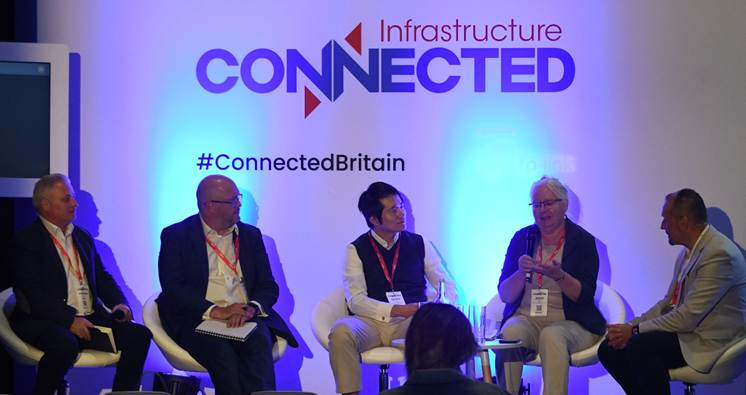
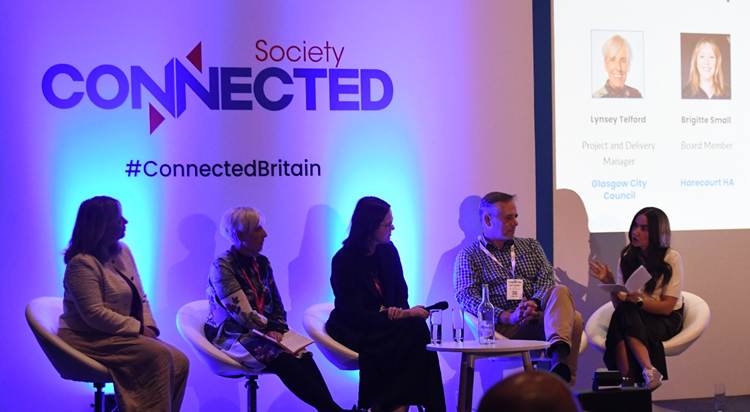
In fact, one phrase surfaced repeatedly throughout the event, particularly during Hayley O’Brien’s Connected Social Housing panel:
“Not another pilot.”
It wasn’t a criticism of innovation, nor a suggestion that pilots no longer have value. Instead, it reflected a growing frustration that the sector has become exceptionally good at proving what technology can do, whilst often struggling to embed and adopt successful projects into everyday delivery.
Several speakers described moving away from pilot environments and towards long-term operational models. Conversations focused less on testing technology and more on governance, organisational change, integration and sustainability. The underlying message was clear. In many cases, we already know the technology works.
The challenge now is how we help organisational change to use it consistently and at scale.
We’re Starting to Talk About Outcomes
Perhaps the most encouraging shift we observed throughout Connected Britain was a growing focus on outcomes rather than technologies.
The strongest examples didn’t start with connectivity, sensors or AI. They started with a problem that needed solving.
In social housing, conversations focused on reducing damp and mould, improving wellbeing and supporting more proactive maintenance. In healthcare, the emphasis was on preventing hospital admissions and enabling earlier interventions. In transport, discussions centred around safer journeys, better decision-making and improved experiences for network users.
What linked these discussions together was a subtle but important shift away from reacting to problems and towards preventing them.
For years, investment in technology and infrastructure was often justified through growth and efficiency. Increasingly, organisations are looking at how those same tools can help avoid problems altogether. That may sound like a small difference, but it changes how projects are planned, how value is measured and ultimately how success is defined.
Chris Founds panel on highways connectivity reinforced this perfectly. While the discussion focused on transport networks, digital infrastructure and data, the conversation continually returned to better outcomes for people. Connectivity wasn’t presented as the end goal. It was presented as the enabling platform that allows better decisions, safer journeys and more efficient services to happen.
One comment from Hayley O’Brien’s panel captured this particularly well:
“Innovation isn’t just the technology. It’s the processes and the people around it.”
It was a simple observation, but one that seemed to resonate across the entire event.
Connectivity Doesn’t Equal Inclusion
Few topics received as much attention during Connected Britain as digital inclusion. However, one of the most important observations was that connectivity alone does not automatically create inclusion.
Hayley O’Brien opened the discussion by reflecting on the increasingly common description of connectivity as the “fourth utility”, before making an important distinction. Having a fibre connection into a property does not automatically mean somebody is digitally included.
It’s an obvious point when stated out loud, yet it remains one of the sector’s biggest challenges.
The industry has invested heavily in digital infrastructure, but people still face barriers around affordability, skills, access to devices, confidence and support. Those barriers don’t disappear simply because infrastructure exists.
One of the most encouraging examples of this was found away from the conference stages. Throughout the event, the Digital Poverty Alliance collected laptops, tablets and mobile devices for refurbishment and redistribution. It was a practical reminder that whilst the sector debates AI, digital twins and connected places, many people are still unable to access the tools needed to participate fully in a digital society.
The contrast felt important.
Perhaps digital inclusion is better understood as a journey from access, to inclusion, to confidence and finally to adoption.
Because connectivity is only the beginning.
Connected Britain 2026
We were incredibly proud to attend Connected Britain 2026 and even prouder to see both our projects and our people recognised alongside some impressive organisations across the sector.
St Helens Borough Council’s Digital Infrastructure Project was shortlisted for the Community Improvement Award.

Hayley O’Brien was recognised as a finalist in the Rising Star category.
Whilst we didn’t bring home an award this year, being recognised alongside so many innovative projects remains something we’re incredibly proud of.
Most importantly, Connected Britain reinforced something we’ve believed for a long time.
The future of digital infrastructure isn’t simply about connecting places.
It’s about creating smarter places, where people can genuinely benefit from the opportunities technology creates.